

Ducts doing their job
This is what a duct system looks like when there's nothing to find. The trunk lines run tight to the joists, the furnace feeds them clean, and the only thing moving through the metal is air. Nothing here needs a cleaning crew.
Get matched with a pro who works on ducts in York County.
Find my proIt depends on what's going on with your ducts, but for most homes in Sanford it isn't something to do on a schedule. Dust buildup alone doesn't hurt your air or your furnace enough to justify it. What does matter is what's actually in there. If you've had rodents or birds get into the ductwork, if there's visible mold around vents, or if a return duct has sat open during construction work, cleaning is worth doing. Most homes heating with oil through the winter also build up more soot and fine particulate near the furnace connections than homes on gas, so if yours smells musty or dusty right when the heat kicks on in the fall, that's worth a look. Short of a specific reason like that, cleaning ducts that are otherwise fine doesn't change your air quality or your heating bill. The answer is: worth it if something's actually wrong in there, not as routine upkeep.
Half the homes here were built by 1980
Half the homes in York County were built in 1980 or earlier. A duct system that old may have been added to or patched over the years, which is worth a look before cleaning gets ruled out.
Heat runs September through May
Heat runs September through May here, about nine months. That's nine months of air moving through the same ducts, carrying whatever dust or debris has settled in them.
Cooling runs July through August
Cooling only runs July and August. With the ducts barely used the other ten months, whatever's sitting in them this winter is still there come summer.
ACS 2020-2024 · NOAA nClimDiv 1991-2020
If a contractor finds rodent droppings, nesting material, or mold growing on the inside of your ducts, cleaning is worth doing. Those get into the air every time your furnace or AC runs, and no filter catches all of it. The same goes if you've had a renovation that left drywall dust or insulation fibers sitting in the supply lines. A camera inspection is the only way to know for sure what's in there, and it's worth asking for one before you agree to anything. Without it, you're paying to find out, or paying for nothing.
If your ducts just look dusty, or you're hoping it'll cut your oil use or ease allergies, the evidence doesn't back that up. Ordinary dust settles and gets pushed through, it doesn't build up to the point of blocking airflow or feeding your bills. Oil heat here runs hard from September through May, and what actually affects your furnace's efficiency is the burner, the nozzle, and the filter, not what's coating the inside of the ductwork. Swap the filter on schedule and have the furnace serviced, and you've covered what dust in the ducts would have cost you anyway.


Answer a few questions instead of calling shop after shop.
No charge to send it. You decide if you hire them.
A real duct cleaning follows a sequence, and it's worth knowing so you can tell a thorough job from a rushed one. The crew sets up negative pressure first, usually a vacuum connected at the main trunk or supply plenum, so that once they start knocking debris loose it gets pulled out of the house instead of blown into your rooms. Then they work branch by branch, running a brush or a whip down each line to break up what's stuck to the walls of the duct. Registers come off throughout the house, supply and return both, because dust tends to pile up right behind the grille where airflow slows down. A full job doesn't stop at the ductwork. The blower wheel, the coil, and the inside of the furnace or air handler cabinet collect the same debris, and skipping them leaves a source of dust that just gets pulled back into the clean ducts the next time the system runs. Ask how the crew checks their own work. A camera run through the lines before and after is the honest way to show you what came out, rather than taking their word for it. If sealing is part of the job, it belongs at the end, once the debris is gone, since sealing over dust just traps it instead of fixing a leaky joint. Any contractor who skips the before-and-after step, or who treats sealing as a separate upsell with no connection to what the cleaning found, is worth a second look before you sign off.



This is what a duct system looks like when there's nothing to find. The trunk lines run tight to the joists, the furnace feeds them clean, and the only thing moving through the metal is air. Nothing here needs a cleaning crew.

Water staining on the foundation wall like this is worth a second look. If moisture has been getting in, check the ducts nearby for mold before deciding cleaning is unnecessary. That's a reason to clean, not the dust sitting on the metal.
At 26.93 cents per kilowatt-hour, running a blower fan to push air through ducts clogged with debris costs more than it should. A furnace or air handler working against buildup pulls more power to move the same air through your house.
EIA-861 2025
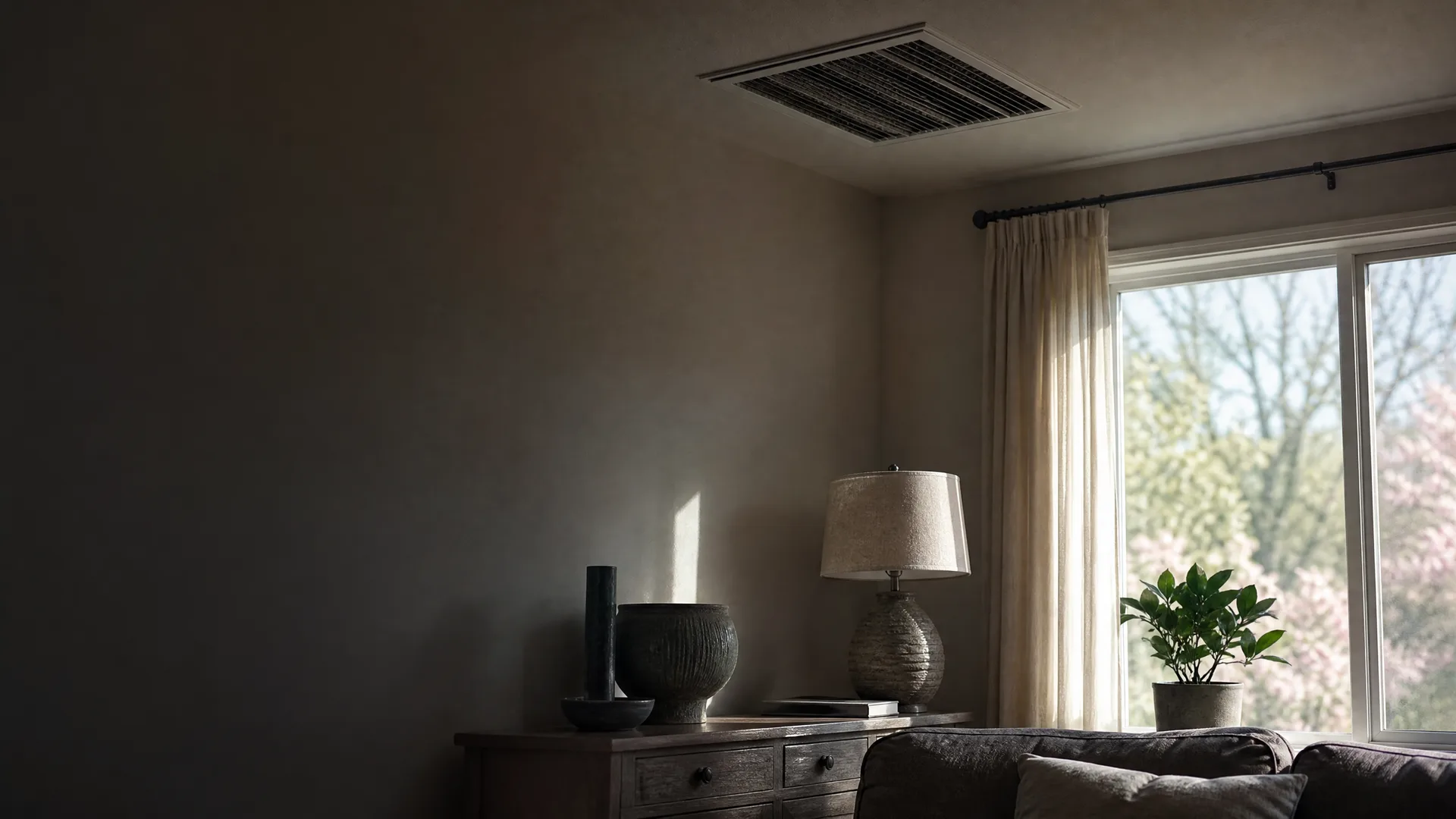
The sun's been up for a few hours and it's cutting across the living room, low enough to catch the ceiling vent at an angle. That's when you see it: a gray fringe of dust along the grille slats, thicker than you'd expect for spring cleaning to have missed. You run a finger along the coffee table underneath it and it comes back coated. You wipe the table down, same as always, and by the following week there's a fine layer back on it. The furnace hasn't run in weeks, just the blower cycling the air conditioner now that the Sanford days are warming up. You look up at the vent again and wonder how long that's been building, and what else might be riding along with it every time the air kicks on.

For most homes around Sanford, the answer sits on what's actually inside the ducts, not on the calendar. Dust alone isn't a reason. Droppings, nesting material, or mold are. A contractor who looks inside your system first, before running a brush down a single line, is the one giving you a straight answer instead of a sale.
That's the part that's hard to do on your own: finding someone who will actually check before they quote you a cleaning. Getting matched with a contractor who handles duct systems in York County means you skip the calling around and the repeating yourself to three different companies. You explain your situation once, to someone who already knows what homes out this way are dealing with, and they reach out to you from there.





Find a duct system cleaning pro in York County
Describe your ductwork job once, to one pro.
